
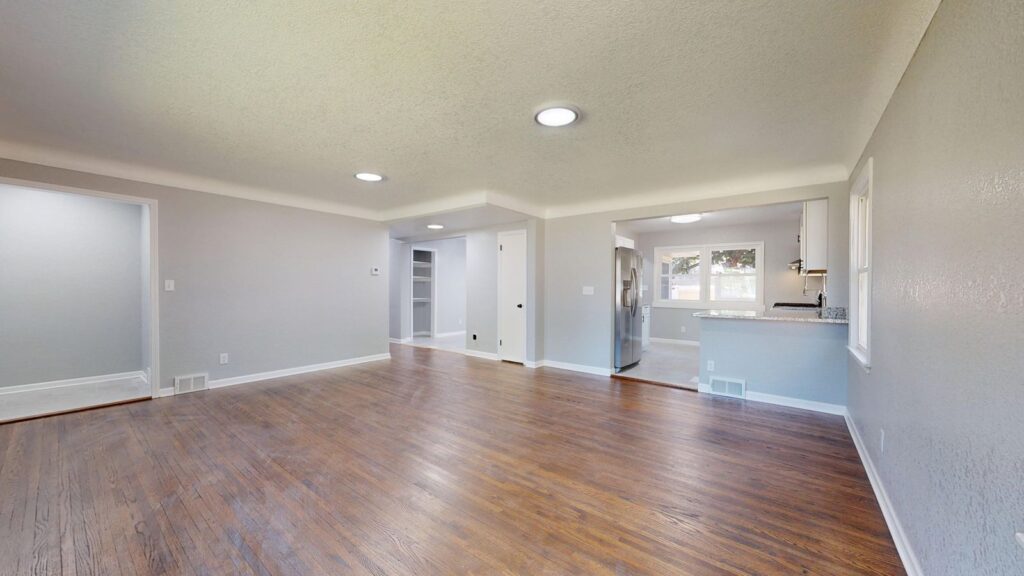
Staging sells a feeling. You’re buying a floor plan.
Those two things get confused constantly, and it costs people real money and about two years of frustration. I’ve watched buyers fall hard for a house because the entry smelled like a candle and the living room had a rug that pulled everything together. Then they move in with their actual furniture, their actual laundry pile, and their actual Tuesday morning, and the house stops working almost immediately.
I spent 15 years in marketing before I got into real estate. My whole job was making things look like the best version of themselves. Now I do that in reverse for buyers. I un-position homes. I look at a listing and figure out what it’s trying to distract me from.
Staging is a marketing tool, and it’s doing its job
I want to be clear that staging isn’t dishonest. It’s good marketing, and I use it on the listing side all the time. A well-staged home shows a buyer how space could feel, which is genuinely useful when a room is empty and echoing.
The problem is that staging speaks to emotion, and emotion is a terrible measuring tape. A few things I see over and over in Lincoln and across Southeast Nebraska:
- Undersized furniture. A loveseat where a sectional should be. A two-person bistro table in a dining room. Small furniture makes rooms read larger in photos and in person.
- Every lamp on, every blind open, mid-morning showings. Light hides a lot. Go back at 6pm in January and that bonus room may feel like a basement.
- The closet that’s been emptied. Three hangers and a single storage bin in a closet tells you nothing about whether your stuff fits.
- Fresh paint on everything. Sometimes it’s just fresh paint. Sometimes it’s the cheapest way to make a wall stop asking questions.
- Photos shot from the one corner that works. If there’s no wide shot of a room, there’s usually a reason. Look for what’s behind the camera.
What I’m actually looking at when we walk a house
Let’s think about how you actually live in a house day-to-day. That’s the standard. Not whether it photographs well.
Where does the day start and end
Where do shoes, backpacks, and coats land when everyone comes in the door? If the answer is the kitchen floor, that’s your new normal. A drop zone isn’t a luxury feature, it’s the difference between a tidy house and a house you’re constantly reclaiming.
Bathroom math at 7:15 in the morning
Count bathrooms against the number of people who need one at the same time. Then look at where they are. A second bathroom on a different level than the bedrooms solves less than you’d hope.
Laundry location, honestly assessed
Laundry in a far corner of the basement means clothes live in baskets on the stairs. That’s not a character flaw, that’s physics. If the layout makes a chore hard, the chore doesn’t get done.
Doorways, walls, and traffic
I pay attention to how many doorways open into a room, because that determines where furniture can go. Four entry points into one living space means one wall for the couch and no good spot for the TV. Open concept sounds great until you realize there’s nowhere to put anything.
Sound and separation
If someone needs to take a call while someone else practices trumpet, where does that happen? Layouts that work for a quiet house fall apart in a loud one.
The reverse also applies to your current home
Here’s the part people don’t expect. The same eye that spots what staging hides is the eye that positions a lived-in home to sell strong. Your house doesn’t need to be perfect. It needs to be presented honestly, with the strengths pushed forward and the compromises priced in instead of covered up. Buyers forgive a dated kitchen. They don’t forgive feeling misled at inspection.
So when we tour homes, we’re building your buyer instincts and your seller instincts at the same time.
Why this matters more when you buy before you sell
When you secure your next home first, the goal is to move once and be done. That plan only works if the house you buy is actually right. There’s no soft landing where you live somewhere temporarily and try again in a year.
So we slow down on the front end. We look at layout truth, storage reality, and how your specific week fits inside those walls. Then we move fast when the right one shows up, and we get your current home positioned to sell on your timeline. We’re not doing anything that puts you in a bad position.
Pretty paint is a coat of paint. A floor plan is the next ten years of your mornings. Buy the floor plan.
If your house technically works but doesn’t work for your life anymore, buying before you sell is the calmest way out: See how buy-before-you-sell works →