
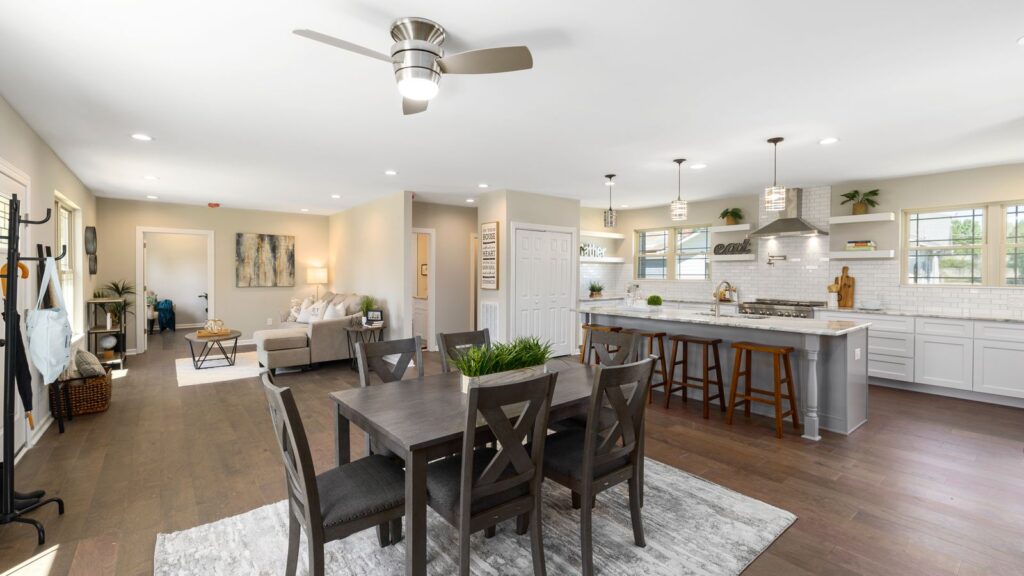
The party is easy. The twenty minutes before it, when someone is trying to get a pan out of the oven while four people are taking off their coats in the same four square feet, is the real test.
That’s the hour you should be shopping for.
Most people tour a house and picture the best version of the evening. Everyone seated. Food out. Music on. Nobody pictures the part where the host is sidestepping a stroller, a stack of coats and a kid asking where the bathroom is, all while holding something hot.
If you’ve stopped hosting because your current house makes it a logistics problem, that’s not a you problem. That’s a layout problem. And layout is the one thing a wide-angle listing photo is specifically designed to hide.
Walk the house the way a Tuesday night actually goes
Let’s think about how you actually live in a house day-to-day. When I’m touring Lincoln homes with move-up clients, we don’t evaluate rooms. We evaluate the path between them. Here’s the sequence I walk, in order, every time.
1. Arrival
Stand at the front door and open it. Where does the first person physically go? In a lot of older Lincoln homes, the front door opens directly into the living room, which means your guests walk straight into the seating you just arranged. In newer builds, the front door can dump into a narrow hall where two people can’t pass each other.
Look for a landing spot. Somewhere a person can stand, take off boots in February, and not block the next three people behind them.
2. Coats and stuff
This is the one nobody checks and everybody suffers. Is there a coat closet near the entry, or is it tucked down a hall past the bathroom? If the answer is “we’ll just pile them on the bed,” that works right up until someone needs to leave early and you’re all digging through a mountain in the dark.
While you’re there, check the drop zone. If there’s a mudroom or a bench with hooks by the garage entry, that’s the same space that keeps backpacks off your kitchen table the other 364 days a year. Hosting space and daily sanity space are usually the exact same square footage.
3. Food prep
Here’s where photos lie the most. A big island looks great in a listing. What matters is whether someone can stand at that island chopping while another person opens the oven and a third person gets into the fridge. If the fridge door swings into the main walkway, you will discover that on Thanksgiving.
Count your landing space too. Where does the hot pan go when it comes out? Where do the appetizers sit? If every flat surface is already spoken for by a coffee maker and a toaster, the food ends up on the dining table before anyone is ready to eat.
4. Seating and spillover
Nobody stays in the room you planned for them. People cluster where the food is. The question isn’t whether the dining room seats ten, it’s whether people can stand in the kitchen without being in the way of the person cooking.
Open concept gets sold as the answer here. Sometimes it is. Sometimes it means noise travels everywhere and there’s nowhere to put the kids who want to watch something. A separate room with a door is worth more than people admit.
5. Cleanup
Walk the dirty plate route. Table to sink to dishwasher to trash. If that route crosses the main conversation area three times, you’re going to spend the end of the night saying “excuse me” instead of actually talking to anybody.
And check the trash situation. If there’s no cabinet for a pull-out bin, you’re hosting with a garbage can in the open. Minor, until it isn’t.
Why the photo never tells you this
Listing photos are shot from the corner of a room with a lens that widens everything. They show you volume. They tell you nothing about flow, doorway width, how many steps it is from the oven to the table, or whether two adults can be in the kitchen at once without a negotiation.
You can only learn that by standing in it and moving through it. So move through it. Walk the loop. Open the fridge. Stand where the coats would go. It feels a little strange in front of a stranger’s house. Do it anyway.
Buying this on purpose instead of by accident
Here’s where most people get stuck. They know what they want, but they’re afraid of listing first, taking the first decent offer, and landing somewhere that solves square footage but not the actual traffic jam.
That’s the whole reason I build buy before you sell plans for clients across Lincoln, Waverly, Seward, Crete and the surrounding Southeast Nebraska towns. We get your current home prepped and ready behind the scenes, then we take the time to find a house that works for the life you’re actually living. Once it’s secured, we list with real strategy. You move once. There’s a way to do this without it turning into chaos.
You don’t need a bigger house. You need a house where the hour before everyone arrives doesn’t feel like a fire drill.
Schedule a quick call and we’ll map out your move.
If your house technically works but doesn’t work for your life anymore, buying before you sell is the calmest way out: See how buy-before-you-sell works →