
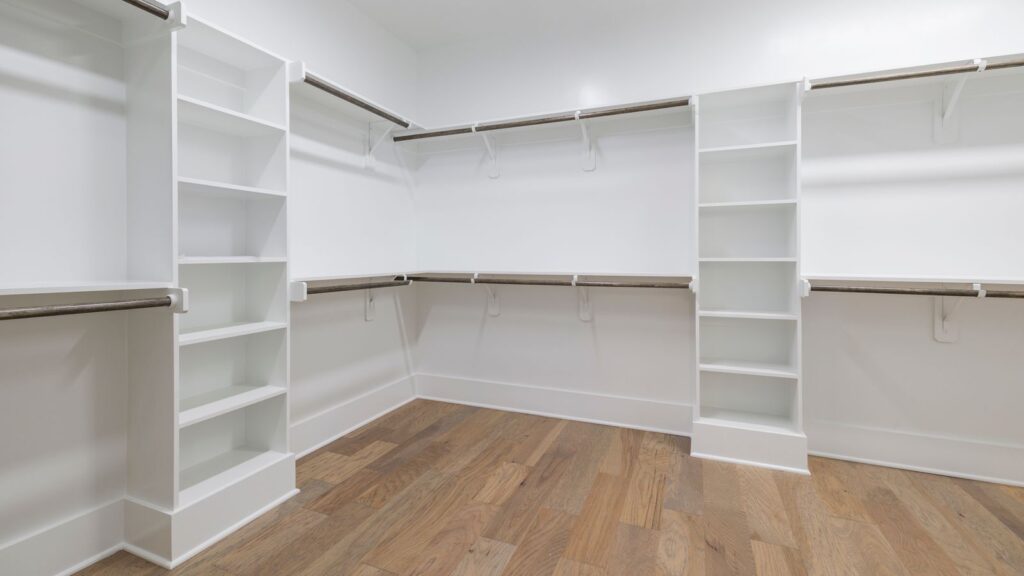
You don’t have too much stuff. You have a house with nowhere to put a life.
There’s a difference, and it matters more than the container aisle wants you to believe. I talk to people all over Lincoln and Southeast Nebraska who are genuinely embarrassed about their clutter. They apologize for the entryway before I’ve even taken my shoes off. And then I walk through the house and see it immediately: there was never a place for any of it to go.
The organizing spree that works for nine days
You know the cycle. You spend a Saturday on the mudroom that is not actually a mudroom. You buy bins. You label things. For about a week and a half, it looks like someone else’s house.
Then Monday happens. Backpacks, work bags, shoes, a basketball, three jackets for two seasons, the mail. It all lands in the same twelve inches by the door because that’s the only place it can land.
That’s not a discipline problem. That’s a floor plan telling you the truth. If a system fails every single time with every single person who lives there, the system isn’t the issue. The house is.
Storage friction is usually a layout verdict
Here’s what I see over and over in lived-in homes that people have taken good care of for ten or fifteen years.
No drop zone
The back door opens straight into the kitchen, or straight into a stairwell. There’s no landing strip. So the kitchen counter becomes the landing strip, which means the kitchen never looks clean, which means you feel behind before dinner starts. One missing square of floor creates daily friction in the busiest room in the house.
The one-car garage doing four jobs
It’s parking. It’s lawn equipment. It’s holiday storage. It’s the overflow pantry and the bike rack and wherever the hand-me-down furniture went. In a Nebraska winter, you either park in it or you store in it. You don’t get both. That’s not clutter. That’s a garage being asked to do the work of a garage plus a shed plus a basement.
No linen closet, and one bathroom running a morning line
Towels live in a bedroom closet. Sheets live under a bed. The single bathroom has a vanity with one drawer, so everyone’s stuff sits on the counter, and the morning turns into a queue with a hairdryer in it. You can’t organize your way out of a missing closet.
Bedrooms doing double duty
Kids sharing a room isn’t automatically a problem. Kids sharing a room that’s also the laundry staging area and the place the vacuum lives, that’s a problem. When every room has a second unofficial job, the house feels loud even when it’s quiet.
How to tell fixable from structural
Not every storage complaint means it’s time to move. Let’s think about how you actually live in a house day-to-day.
- Fixable: One closet is badly configured. A shelving system or a better rod setup genuinely solves it.
- Fixable: You’ve never purged. If you haven’t opened a bin in four years, start there before you start touring homes.
- Structural: There is physically no entry space, no linen storage, and no secondary storage anywhere on the property.
- Structural: Solving one problem creates another. Moving laundry upstairs means losing the only pantry. That’s a house at capacity.
- Structural: The friction repeats daily and has for years. Daily friction compounds. It’s the thing people underestimate most.
What to look for in the next floor plan
When my clients move up, I tell them to stop counting bedrooms and start counting landing places. Square footage lies. Layout doesn’t.
- A real drop zone between the garage or back door and the living space. Even a small one changes the whole rhythm of a weekday.
- Laundry on the same level as the people who generate laundry. Stairs are why baskets live in hallways.
- A second bathroom with actual storage, not just a second sink.
- A pantry that isn’t a cabinet wearing a nametag.
- Garage depth and a basement or outbuilding. In Lincoln, Waverly, Seward, Crete, and the smaller towns around us, outdoor and seasonal storage is not optional. It’s how life here works.
- Closets in the rooms where people actually get dressed, sized for two seasons at once.
The part people get stuck on
Most people who need a better layout wait years anyway, because the move itself sounds worse than the clutter. They picture packing twice, renting something temporary, and carrying two houses at once.
That’s the part I plan around. We prep your current home quietly, figure out your real options, and structure it so you secure the next house first and sell strategically after. Buy before you sell exists so you move once. We’re not doing anything that puts you in a bad position, and we’re not listing before you’re ready.
Your house isn’t failing because you’re disorganized. It’s failing because it ran out of room for the life you’re currently living.
If your house technically works but doesn’t work for your life anymore, buying before you sell is the calmest way out: See how buy-before-you-sell works →