
It’s never the house. It’s the fourteen small collisions before 8am.
The backpack that lives on the kitchen chair. The shoes piled by the front door like a garage sale. The person brushing their teeth while another person hovers in the hallway waiting for the one bathroom. Nobody sat down and designed your morning to be this chaotic. It just happened, one small layout gap at a time.
Let’s think about how you actually live in a house day-to-day. Because when people tell me they’ve outgrown their home here in Lincoln, they almost never mean square footage. They mean the friction. And most of that friction comes from three or four spots in the house that quietly run the whole show.
The drop zone that doesn’t exist
Here’s the thing about a drop zone. When a house doesn’t have one, the whole house becomes one.
Keys land on the counter. Mail stacks on the table. Shoes migrate. Coats hang off the back of a dining chair because there’s nowhere else. It’s not a clutter problem. It’s a design problem. There is no landing spot built into the path you actually walk every day, so your stuff lands wherever your hand happens to be.
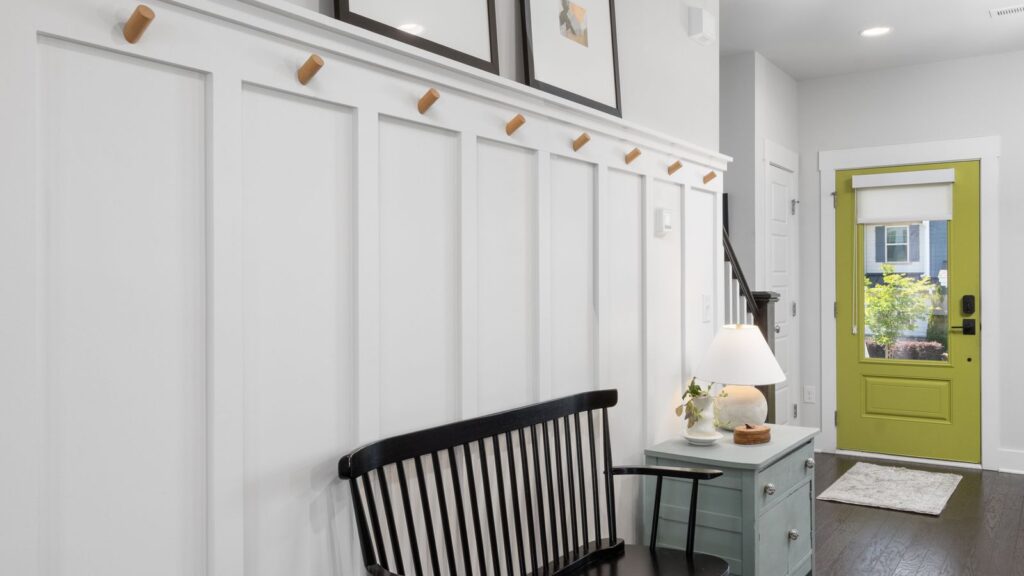
A real drop zone is a small thing that fixes a big thing. Hooks, a bench, a spot for shoes, right where you come in. When you tour a house, don’t look at the entryway for how it photographs. Look at it for where fourteen items land the second everyone walks in.
Laundry on the wrong floor
Nobody notices laundry placement in listing photos. Everybody notices it at 6am with a load of gym clothes and a flight of stairs between them and the machine.
Laundry in the basement when the bedrooms are on the second floor means you are hauling baskets up and down two levels for the rest of your life in that house. That’s not a dealbreaker on its own. But it’s the kind of gap that photos will never show you, and it’s the kind of gap you feel every single week.
When you walk a house, trace the laundry path. Where do the clothes get worn, and where do they get washed. If those two things are on opposite ends of the house, know that going in.
The bathroom line
One full bathroom and a house full of people getting ready at the same time is a math problem with no good answer. You already know this if you’re living it.
When you’re looking at your next home, don’t just count bathrooms. Look at where they are. Two bathrooms clustered together don’t solve a morning rush the way two bathrooms on opposite sides of the house do. Placement beats the number almost every time.
How to spot layout fixes photos never show
Listing photos sell rooms. They don’t sell the flow between rooms, and the flow is what runs your day. Here’s what I have clients pay attention to on a walk-through:
- The entry path. Walk in like it’s a school morning. Is there a spot for coats, bags, and shoes right there, or does everything have to travel deeper into the house.
- The kitchen drop. Is there counter space near the door for mail, keys, and the stuff people carry in. Or does it all pile onto the cooking surface.
- The laundry route. Bedrooms to washer. Count the stairs.
- The morning bottleneck. Where do bathrooms sit relative to bedrooms. Picture everyone moving at once.
- The breathing room. Is there any spot that isn’t a walkway. A place to just sit that nobody has to pass through.
None of this shows up in a wide-angle photo with good light. All of it shows up in your Tuesday.
Why this matters before you buy
The reason I push on layout so hard is that you can’t renovate your way out of a bad path cheaply, and you shouldn’t have to. It’s far easier to find the right layout on the front end than to fight the wrong one for years.
This is also why I have my Lincoln and Southeast Nebraska clients buy their next home before selling their current one. When you’re not rushing to beat a listing clock, you have room to walk a house slowly and ask whether it actually fits your life, not just whether it fits your stuff. We’re not doing anything that puts you in a bad position. We map the move so you go from one home to the next without temporary housing and without carrying two homes at once.
The house that fits isn’t the one with the most rooms. It’s the one where the morning stops fighting you. Find that layout, and the fourteen collisions drop to zero.
If your house technically works but doesn’t work for your life anymore, buying before you sell is the calmest way out: See how buy-before-you-sell works →