
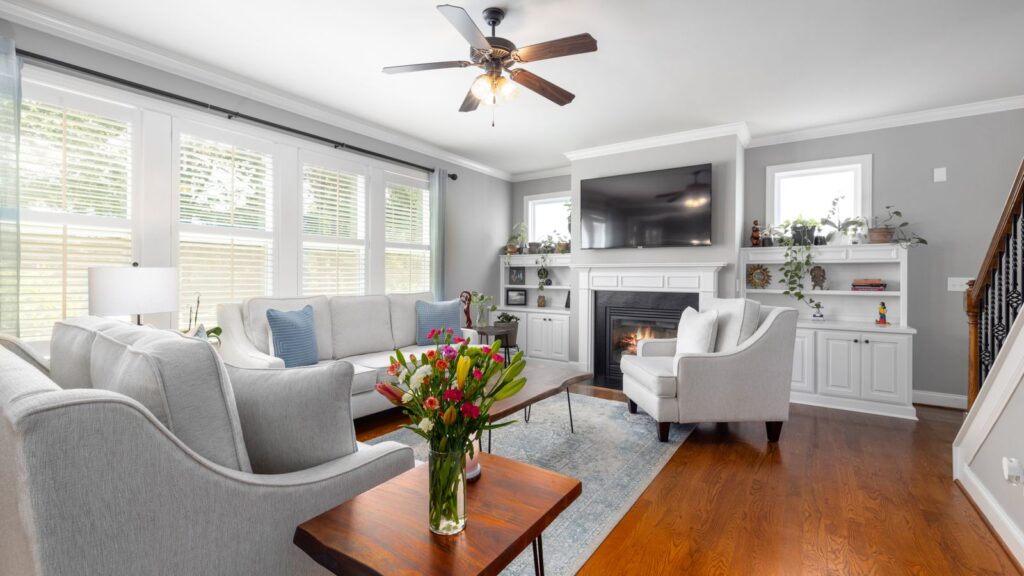
Nobody is buying your couch. Buyers are standing in your living room trying to picture their next life, and a rented accent chair has never once been the thing that got them there.
I say this as someone who sells lived-in homes in Lincoln and across Southeast Nebraska. Real homes. With a basketball hoop in the driveway, a laundry pile that has become a permanent resident, and a hallway wall that has taken some hits. The question I get constantly is some version of: do we need to stage this before we list?
Mostly, no. But there’s a version of “yes” that matters, and it’s smaller and cheaper than what you’re imagining.
What staging is actually supposed to do
Staging has one job: help a buyer read the house quickly. That’s it. Not impress them. Not make your home look like a catalog. Just make the layout, the light, and the flow obvious in about eight seconds, because that’s roughly how long you get in a photo scroll.
When people hear “staging,” they picture furniture rental trucks and a designer telling them their kitchen table is wrong. That’s the expensive version, and in a home you’re still living in, it’s usually theater. You spend energy and money making the house look like nobody lives there, then you keep living there, and by day nine the whole thing collapses back into real life anyway.
Let’s think about how you actually live in a house day-to-day. Then let’s spend effort only where a buyer will notice.
Where the money and effort actually move the needle
1. Light
This is the highest return thing you can do and it barely costs anything. Wash the windows, inside and out. Open every blind to the same height. Replace the dim, yellowed bulbs so every fixture in a room matches. Pull the heavy drapes off the rods if they’re eating the window.
A dark room reads small and dated in photos even when it isn’t. A bright room reads bigger than it is. Same house, different story.
2. Flow
Walk your main path through the house the way a buyer would. Front door, living space, kitchen, hallway, bedrooms. Anywhere you have to turn sideways or step around something, fix that. Usually it means removing furniture, not adding it.
Most lived-in homes have one too many pieces in every room. The extra recliner, the second bookshelf, the toy bin that migrated in and never left. Take the biggest offender out of each room and put it in the garage. Rooms feel larger with fewer things in them, and buyers subconsciously measure a house by how easy it is to move through.
3. The first photo
One photo does most of the work in your listing. It’s the one that decides whether someone taps in or keeps scrolling. That shot needs to be lit well, shot at the right time of day, and framed on the strongest thing your home offers. That might be the kitchen, the backyard, the finished basement, or the front elevation with the trees in leaf.
I spend real time on that decision. Positioning is the whole game with a lived-in home, and the first photo is positioning compressed into one frame.
4. Surfaces buyers touch and look at
Counters, the kitchen sink area, bathroom vanities, and the entry. Clear them almost completely. Not styled with a bowl of decorative spheres. Just clear. It signals “this house is cared for” faster than anything you could buy.
Where it’s just theater
- Rented furniture in an occupied home. You’re paying to look like someone else lives there while you still live there.
- Buying new decor for the photos. Buyers are not evaluating your throw pillows.
- Repainting every room a neutral color when your current colors are fine and simply not what a designer would pick.
- Renovating to “compete.” If you weren’t going to remodel the kitchen for yourself, don’t remodel it on your way out the door.
- Staging the rooms buyers spend nine seconds in. Nobody bought a house because the guest room had a chair in the corner.
Positioning beats perfection
Here’s the honest part. Your house does not have to be the nicest one a buyer sees. It has to be the clearest one. When the light is good, the flow is open, the photos lead with strength, and the price matches the actual condition, lived-in homes sell well. I’ve watched it happen repeatedly in Lincoln, Waverly, Seward, Crete, and the smaller markets around them.
What kills a sale isn’t a scuffed baseboard. It’s a house priced like it’s updated when it isn’t, then quietly sitting while buyers assume something is wrong with it.
And if you’re upgrading into something that fits your life better, this matters even more, because your listing plan and your buying plan have to run on the same clock. That’s the part I map out first, so you’re not making prep decisions in a panic or moving twice. There’s a way to do this without it turning into chaos.
Skip the furniture truck. Clean the windows, open the rooms, and lead with the strongest thing you’ve got.
If your house technically works but doesn’t work for your life anymore, buying before you sell is the calmest way out: See how buy-before-you-sell works →